How to make a game with AI using Claude Code
To make a game with AI, give Claude Code a brief, build from its design, then play and fix the result.
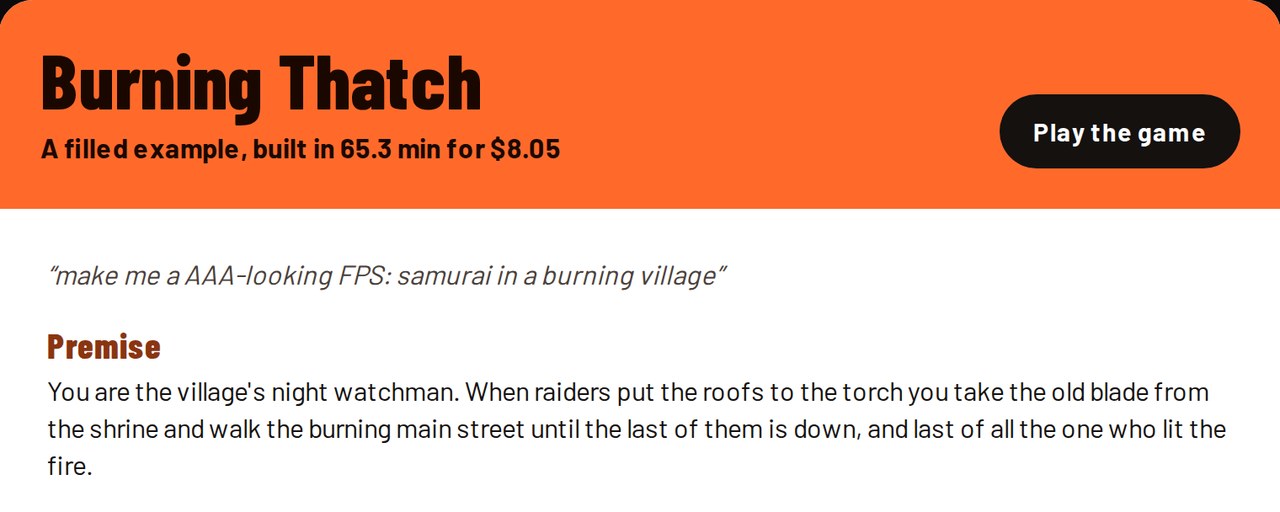
make me a AAA-looking FPS: samurai in a burning village65.3 minof Claude Code
$8.05initial build usage
Start in your own folder
Follow the kit setup steps for the first-person starter and assets. Open Claude Code in an empty project folder and copy the sentence above. Ask it to save the design as design.md before it builds, so you can change the setting, the main action and the win condition together.
Read design.md. Build the game it describes as one HTML file. Play a whole round, reach win and loss, and check restart before handing it over.New to Claude Code? Anthropic's quickstart covers installation and opening a project. Its instruction is direct: Start your first session
. The plugin documentation explains how packaged skills load into that session. Once your project opens, follow the same six steps below.
The build clock
Burning Thatch reached its first playable build 11.7 minutes after setup. The next recorded events concern the sword grip, the test player and the lighting.
- 0.0 min
The sentence goes in
- 11.7 min
First playable build
- 38.2 min
Grip and playtest faults found
- 65.3 min
Lighting fault found and regraded
- 65.4 min
First-pass final play
The run, step by step
Type one sentence
Claude Code writes the design first
Premise
You are the village's night watchman. When raiders put the roofs to the torch you take the old blade from the shrine and walk the burning main street until the last of them is down.
Get the template this page followsIt builds from a starter that already runs
The first playable build lands at 11.7 minutes
Three things broke, and checks caught them
- The katana model's grip point sat at the guard, so the player and the raiders held the blade.
- The playtest looked for a reload and a weapon swap. A sword has neither, and its scripted player lost the round twice.
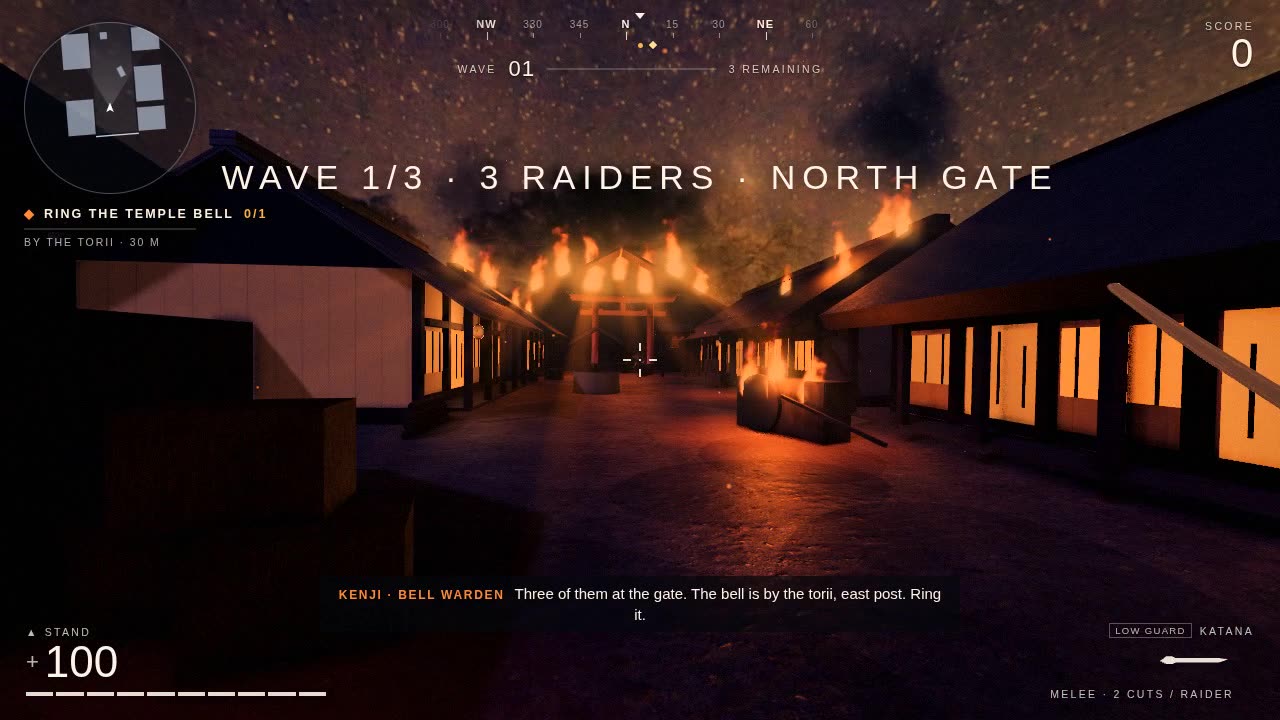
- A picture check scored the look 3 out of 10 because the lighting had turned the street orange and black. Claude Code switched to a cool moon fill and lower contrast.
You play it
Ask for a repair you can check
Check the hand and blade
The repair entry says player and raiders gripped the blade
. Ask for the grip point to sit on the hilt, then look at both the first-person hands and an enemy's sword during an attack. A model loading successfully does not establish the right attachment.
Test the actions this game has
A sword has no magazine to reload. Ask the agent to replace reload and weapon-swap assertions with swing, hit, damage, three-wave completion and restart checks. Run the round again after changing enemy health or wave size.
Look at the playable view
The visual review reported orange-and-black lighting and a bloomed blade. The recorded repair used cool moon fill, lower contrast and a higher bloom threshold. Ask for a fresh frame from the same camera after each change so you can compare the street and sword.
Read the original repair entries and download the design. Keep each requested fix tied to an observable result when you adapt this game.
For a first-person browser game, include click-to-start and Escape in that check. MDN's Pointer Lock guide explains why mouse-look needs a user gesture and how Escape releases it. Ask the agent to verify that clicking back into the game restores camera control.
Play the other kit games and compare their build times and API costs. For other approaches to browser 3D, see the portal's WebGL games.
Choose your next game
Shape a brief before building with the Claude game design skill. Download its instructions and try a small delivery game whose carrying limits and deadline you can change.
Build a smaller example you can edit from start to finish: a browser delivery game, a 3D courtyard with collision boxes, or a horror encounter with a warning and escape route. Each guide includes its playable game and HTML source.
Questions
Can AI make a game?
Yes. A coding agent such as Claude Code can write, run and fix a game's code from a description. On this page it built Burning Thatch, a first-person sword game, from one sentence in 65.3 minutes for $8.05, and you can play the result.
How long does it take to make a game with AI?
Burning Thatch reached its first playable build 11.7 minutes after setup. The initial run took 65.3 minutes in total. Later refinements are separate.
How much does it cost to make a game with AI?
Burning Thatch’s initial build cost $8.05 in model usage at 3 November 2026 prices. The kit is a separate $29 a year purchase. For Burning Thatch, that is $37.05 for the kit's first year plus this one initial build, using metered model usage; Claude subscription billing depends on your plan.
Do I need to know how to code to make a game with AI?
You do not write the code. You describe the game, play what comes back and ask for changes. You do need Claude Code running in a terminal, because the agent works in a folder on your computer.
What can go wrong when AI makes a game?
In the Burning Thatch run, checks found three faults before the end: the sword was held by its blade, the playtest looked for a reload a sword does not have, and the look scored 3 out of 10. The run records a lighting regrade with cool moon fill, lower contrast and a higher bloom threshold.