Claude Game Studio

Game design document template

This game design document template turns a game idea into eight buildable sections, with a complete playable example.

Download PDFDownload Markdown
See filled example

Copy for Docs or Notion, then paste into your own document. PDF and Markdown download directly.

65.3 minof Claude Code

$8.05initial build usage

The initial build from this design. Open its measurements.

Then tell Claude Code

Read design.md. Build the game it describes as one HTML file, and play it in a browser before you hand it over.

The template

This is the page the buttons copy.

  1. 1

    Premise

    One line someone would repeat to a friend.

  2. 2

    First second

    What is on screen and moving in the very first frame? If you cannot picture it, the idea is not sharp yet.

  3. 3

    Main verb

    What the player does most, then the two things that support it.

  4. 4

    Loop

    Do, reward, escalate. Say how each system feeds the next.

  5. 5

    Scope

    Place: one. Enemies: two or three kinds. Tools: two or three. Round: under five minutes, with a win, a loss and a restart.

  6. 6

    Look

    Five words, and four colors with hex codes. Time of day, weather, and the one thing that glows.

  7. 7

    Sound

    The air of the place, and what the main action sounds like.

  8. 8

    Done means

    Three things a stranger must be able to do, each written so a test can check it.

Burning Thatch

A filled example, built in 65.3 min for $8.05

Play the game

“make me a AAA-looking FPS: samurai in a burning village”

Premise

You are the village's night watchman. When raiders put the roofs to the torch you take the old blade from the shrine and walk the burning main street until the last of them is down, and last of all the one who lit the fire.

First second

Looking north up a timber street at night. Thatched roofs on both sides are on fire, embers lift past the camera, smoke rolls across a red-lit shrine gate at the far end, and a long blade rests in bare hands in the foreground, swaying with the stride.
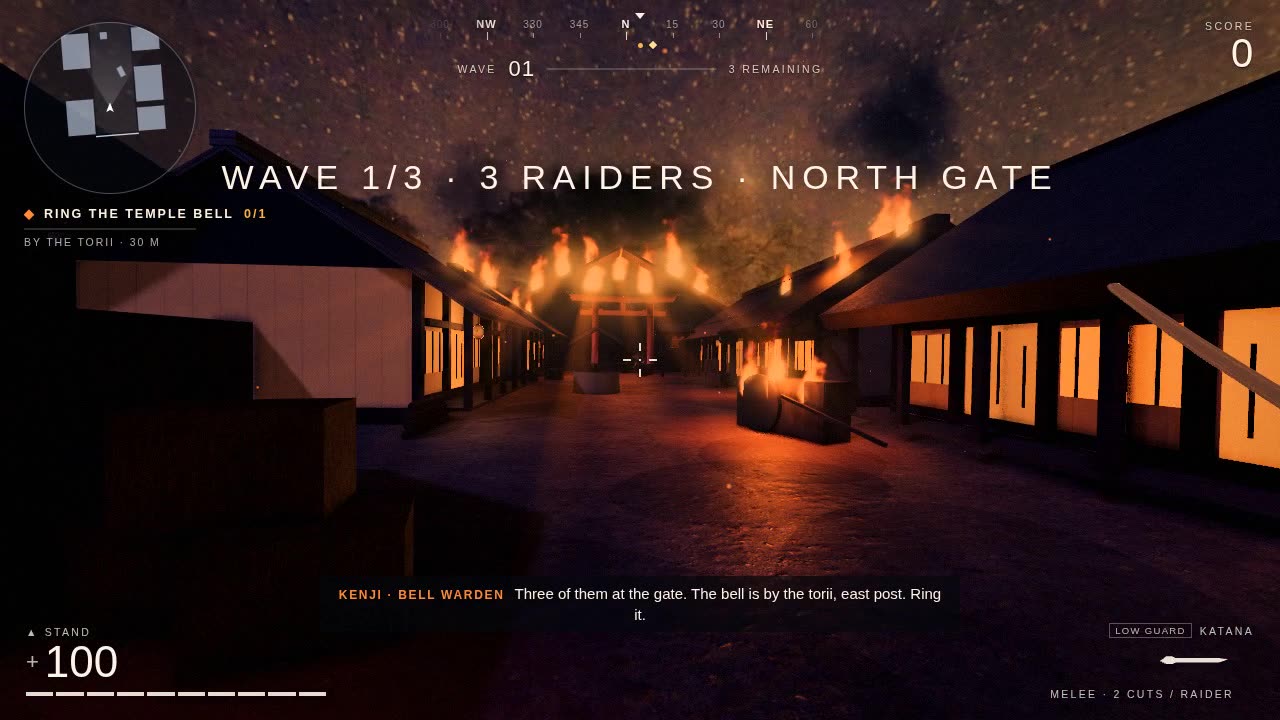
Burning Thatch's village street with burning roofs, a red gate and the sword at the right
The playable revision. The roofs, gate and blade make the opening description visible; its bell objective was added in the second pass.

Main verb

Cut. Also: close the distance before a raider's swing lands, and step out of a telegraphed overhead strike.

Loop

Raiders come up the street from the gate and the side alleys, square up in a sword stance and wind up a visible strike. You cut first: two cuts drop a raider, one cut drops a runner. Each falls on a real death animation. The next wave is bigger and faster, then the Torchbearer, who started the fire, walks out of it.

Scope

  • Place: one village street, about 12 × 48 m, timber-and-plaster houses on both sides with thatch and tile roofs, two side alleys, a well and a cart in the middle, a shrine gate at the north end.
  • Enemies: the Raider (straw hat, two cuts), the Runner (bare-headed, jogs in fast, one cut) and the Torchbearer (larger, lacquered plates, a burning pole in his left hand beside the sword, walks slowly, many cuts, last wave).
  • Tools: one katana, held two-handed.
  • Round: three waves, about three minutes. Win, loss and restart included. Keyboard, mouse and touch.

Look

Night, fire, thatch, smoke, embers. Charcoal #141012, ember orange #ff7a2a, lantern red #c8321e, moonlit blue #3a4a6e. The burning roofs are the key light; paper lanterns on the eaves and a cool moon fill everything else.

Sound

Fire crackle and a low wind under taiko drums. The blade swings with a sharp whoosh; a hit is a wet cut with a flinch.

Done means

  • A stranger can walk, sprint, jump, look and swing the katana with mouse, keyboard or touch.
  • All three waves can be cleared, which shows the win screen; dying shows the loss screen, and both restart.
  • The opening view shows at least two burning roofs, rising embers and the katana in hand, never a black screen.
See the design in the game

The filled example specifies a street, a visible blade and three enemy waves. Use those decisions to judge the game, then change the design before asking for a new build.

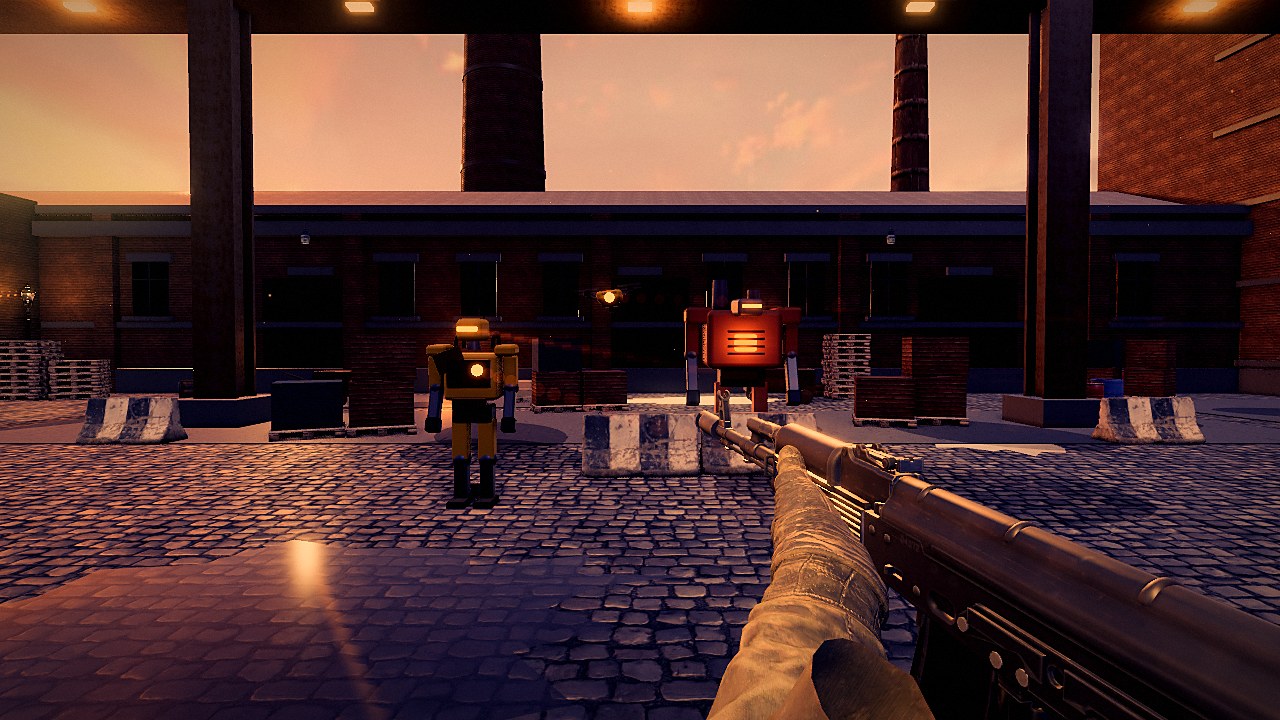
Burning Thatch gameplay showing the village street, burning roofs, red gate and sword at right
The playable version of Burning Thatch. Compare the street and held sword with “First second” in the design. Open the game.

Turn a sentence into a check

“All three waves can be cleared, which shows the win screen; dying shows the loss screen, and both restart.”

That is the design's second completion condition. Ask the agent to reach both end screens and restart from each. A screenshot of the street alone cannot check any of those outcomes.

Download the original filled design

Write the loop as actions

  1. 1

    Approach

    Raiders enter from the gate and side alleys. Close the distance to start a fight.

  2. 2

    Read the swing

    Each raider winds up a visible strike. Step away before the overhead attack lands.

  3. 3

    Cut

    The design gives a Raider two hits and a Runner one. This makes enemy roles readable in play.

  4. 4

    Raise the pressure

    The next wave grows, ending with the Torchbearer. Clearing all three waves is the win condition.

The loop from the filled design, broken into player decisions. Replace the actions and escalation together when you adapt the template.

Keep track of scope changes

The first design

One street, one katana, three enemy types, three waves. The round targets about three minutes. The document includes movement, combat, a win, a loss and restart.

The documented second pass

A temple bell objective appears: stand beside it for two seconds. The HUD gains a compass and minimap. Clearing the three waves still wins, so the new objective does not replace the original completion test.

Both versions are in the original design. The 65.3-minute / $8.05 figure describes the initial build; later changes are separate work.

Make the template yours

Change the action first

If your game is about deliveries, replace “cut” with “deliver,” then rewrite the loop around pickup, route choice and drop-off. Decide what ends one round. Keep the place, enemy or obstacle list and tools small enough that every item has a purpose in that loop.

Write a first frame you can sketch: where the camera sits, what moves and what the player can do immediately. Use exact colors or a reference image for the look. Give the main action a sound, then describe a win, a loss and a restart that another person can check.

Choose a format that fits

For broader planning, Milanote's GDD describes a single point of reference and includes boards for characters, environments and visual inspiration. It suits a project whose visual research needs room to grow.

Double Coconut's high-level template includes vision, art, screens, economy and assets for estimating a team-built game. Its advice that pictures are really worth 1,000 words is useful here too: add a game frame beside a description you want someone to implement.

Use it with Claude Code

For a standalone download, try the Claude game design skill. It guides the choices that fill this document, with a playable delivery example showing how carrying limits and a deadline affect the round.

Want Claude Code to write the page for you? The Claude Game Studio kit has a design-brief skill that turns one sentence into this page. Not sure what to build? Try the game idea generator, then see how a whole game gets made with AI.

Questions

What is a game design document?

A game design document, or GDD, is a written plan of what a game is, how it plays and how it looks, so everyone building it works from the same page. For a first game, one page is enough.

What should a game design document include?

Start with the premise, the first second the player sees, the main verb, the loop, the scope, the look, the sound and what done means. This template has a section for each, and the filled example on this page shows each one.

Can an AI coding agent build a game from a design document?

Yes. Claude Code wrote the Burning Thatch design from one sentence, then its initial build took 65.3 minutes and $8.05 in model usage. The linked game also includes later revisions. Download the original design to see how its scope changed.

How long should a game design document be?

For a first game, one page. Longer documents suit bigger teams, and every added page is more to keep current as the game changes. This template stays at one page so you can paste it into a chat and have it read in full.

How do I use this template with Claude Code?

Fill in the sections, or give Claude Code your one sentence and let it fill them, then tell it to build the game from the file and play it before handing it over. The Claude Game Studio kit includes a design-brief skill that writes this page for you.