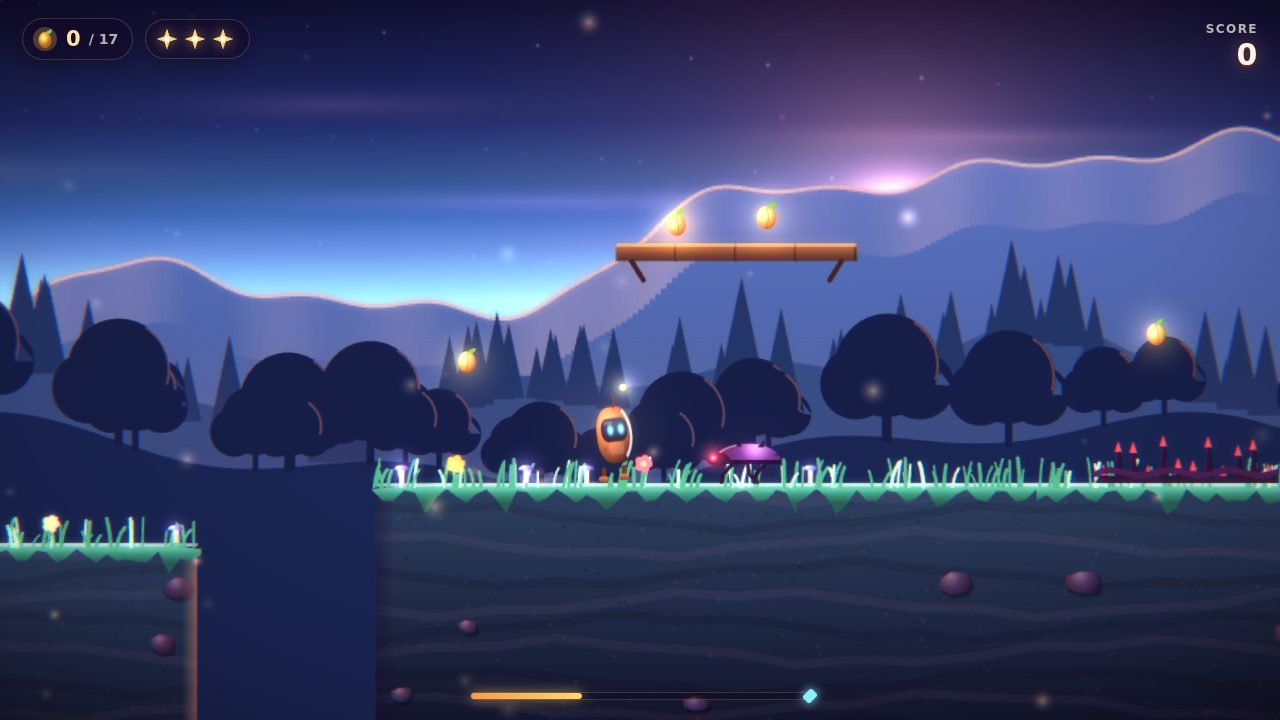
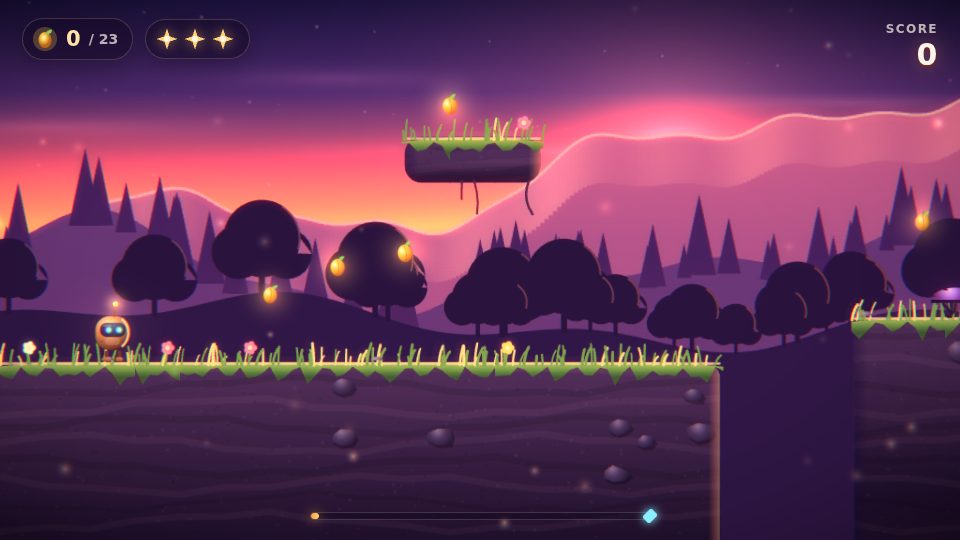
How to make a platformer game
To make a platformer game, give the hero a run and a jump, build a level it can finish from ground, pits and ledges, add one enemy to stomp and a goal to reach, then play it. This guide builds Tidewick, a hermit crab with a lantern for a shell, from one sentence in 9.1 minutes.
Arrow keys or A and D run, Space or W jumps. On a phone, use the buttons at the bottom.
Play in a full tabDownload gameNotices- 9.1 min
- from the sentence to a passing playtest
- 1%
- of a Claude Max week (estimate)
- 31 of 31
- playtest checks passed after one repair
- 263 KB
- one HTML file, no image files
Based on one Cold Chain session on Claude Max 20x (16 Nov 2026) that included other work.
1. Start from a platformer that already plays
You copy a working platformer and change it. The kit's platformer-2d starter runs on the LittleJS engine and draws everything in code. It already has running, a held jump with coyote time, stomping, checkpoints, a camera that leads where you run and a bot that plays a round. Start from the copy so you can always compare with what you began with.
Engines built for beginners take a different route. Construct 3's platformer tutorial walks through the basics in its editor and uses CC0 assets made by Kenney. Here there is no editor and no asset hunt, because the starter paints its own sprites.
npm run new -- tidewick --from=starters/platformer-2d
npm run build -- --game=games/tidewickThe copy lands in games/tidewick/ and you edit only src/game/. The unedited starter builds to about 262 KB, so the first build also tells you the toolchain works.
2. Write one sentence that names the hero, the place and the goal
You give the agent a hero, a place and a way to win. We gave Claude Code this sentence and the kit's timing command (receipt) recorded the clock. Every phrase in it decided something in the game, and the table shows which.
The sentence does not say how high the hero jumps or how wide a pit is. Those numbers stay in the starter, where a test already proves them. Describe the game, and keep the feel for a later pass.
Make a platformer where a hermit crab with a lantern for a shell crosses a tidal flat at dusk, gathering pearls and relighting the buoys until it wakes the lighthouse.| The phrase | What it decided in Tidewick |
|---|---|
| a hermit crab with a lantern for a shell | The hero: a coral-orange crab under a glass lantern that glows and lights the rock around it |
| a tidal flat at dusk | The palette: violet-navy sky, a coral horizon, wet blue rock and teal kelp |
| gathering pearls | 23 floating pearls worth 100 points each, laid out along the route |
| relighting the buoys | 4 checkpoints: touch a buoy and a fall sends you back to it |
| wakes the lighthouse | The goal at tile 96, a striped tower with a lamp room that lights and fires a beam |
3. Draw the hero and the enemy in code
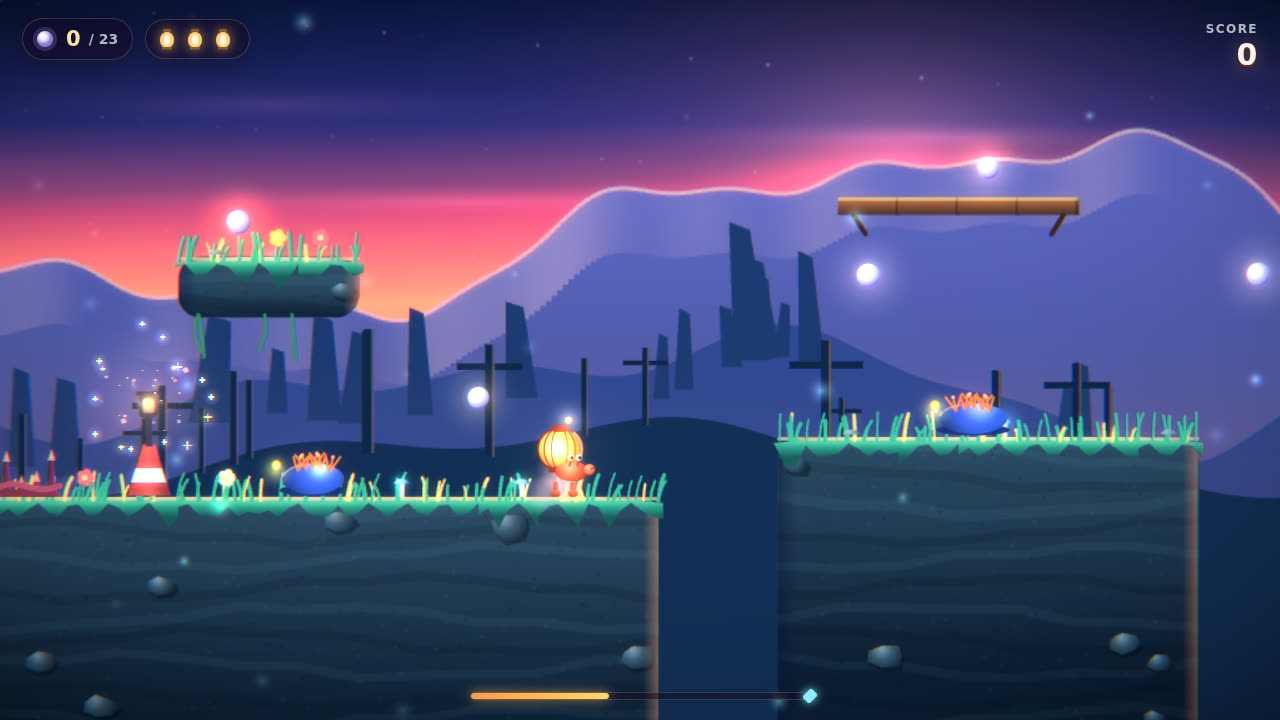
You redraw six sprites and re-skin the terrain in src/game/art.js. The hero is a crab under a glass lantern, the enemy is a blue sea slug with orange gills, the pickup is a pearl, the checkpoint is a striped buoy and the goal is a lighthouse. The starter's painter turns its moss into kelp, its roots into hanging weed and its pine ridge into sea stacks, and the palette in config.js does the rest.
Keep the sprite names the game code already calls. Tidewick still calls its hero robot inside the file, and nothing else had to change, so the movement and the stomp rules stayed tested. A new look is a file of drawing functions, and the physics keeps working underneath it.
4. Build a level the hero can finish
You write the level as lists of pieces in src/game/level.js. Ground is [fromX, toX, top], coral is a start and an end, and pearls, slugs and buoys are positions. Tidewick has ten ground pieces, four pits of 2 or 3 tiles, three coral patches, six slugs and four buoys.
Two rules from the starter keep a level finishable: a pit at most 3 tiles wide and a step up at most 2 tiles. The kit's bot plays the level with the same actions as a player, so it is a finishability test. MDN's tilemap article notes that a tile map maps to a logical grid you can use for collisions and path-finding, which is the same idea in plain JavaScript.
5. Play it, read what broke and fix it
You run the playtest and read the one check that failed. The first build passed 30 of 31 checks. The failing one was a full round is played to a win
: the bot lost all three lamps, near tiles 64, 75 and 88. Coral at tile 64 sat one tile past a step, a buoy at 88 sat beside coral at 89, and the last slug stood at the lighthouse.
The repair was edits to level numbers: coral moved from 64 to 66 and from 89 to 91, the buoy from 88 to 87 and the last slug from 97 to 94. The next run passed 31 of 31 and the bot won a round of 16.3 seconds with 1,800 points, still losing one lamp to a slug at the step near tile 75. A level can obey the pit and step rules and still crowd a landing, which only a played round shows.
| Moment | UTC, 24 November 2026 | Minutes |
|---|---|---|
| Sentence given to Claude Code | 16:53:02 | 0.0 |
| First build opened | 16:56:05 | 3.1 |
| Repair noted | 16:58:29 | 5.5 |
| Playtest passing, captures read | 17:02:09 | 9.1 |
The stamps are from the receipts file. The minutes leave out the time spent reading the starter first. The dollars are the Claude Sonnet 5.5 requests recorded between the first and last stamp, priced at API list prices. Open the run record or the full playtest report.
npm run playtest -- --game=games/tidewick
npm run capture -- --game=games/tidewick6. Tune the jump last, one number at a time
You leave the movement alone until the level plays. Tidewick uses the starter's numbers unchanged: 7.8 tiles a second of running, a held jump that rises 3.38 tiles and 0.1 seconds of coyote time. The playtest measures the rise on every build, so a changed number shows up as a changed result.
When the round plays well, change one number, play the first pit and keep or revert it. The 2D game guide lists the six movement values and what each does. The starter is part of the $29 a year kit on the pricing page, with nine other genres, and Claude access is billed separately. To play a platformer someone else made, try Pixel Princess Platformer on Claude Code Games.
Questions
How do I make a platformer game?
Give the hero a run and a jump that feel right, build a level from ground, pits and ledges that the hero can finish, add one enemy to stomp and one goal, then play it. This guide starts from the kit's platformer starter and ends with Tidewick, a level of 100 tiles with 23 pearls and 6 enemies.
What do I need to make a platformer?
You need movement with a jump, solid ground, a camera that follows the hero, something to collect, something to avoid and a way to win or lose. The kit's platformer-2d starter already has all of them, so a new platformer means redrawing its art, rewriting its level and changing its text.
How long does it take to make a platformer?
Changing the starter into Tidewick took 9.1 minutes of Claude Code, from the sentence to a passing playtest and captures read, on 24 November 2026. That included one repair round. The requests in that window used an estimated 1% of a Claude Max week.
How do you make a platformer level the player can finish?
Keep every pit no wider than the longest jump and every step no taller than the jump's rise, and leave room to land between a step and the next hazard. Tidewick keeps pits to 3 tiles or less and steps to 1, and a bot that plays the level proved it by winning.
Can Claude Code make a platformer from one sentence?
Yes, from a starter that already runs. One sentence set the hero, the place and the goal for Tidewick. The first build failed its own playtest because the bot lost the round, and the repair was respacing three objects in the level file.